
Buyers
Planning to buy a property?
Are you ready?
Buying a property can be challenging. There are many aspects that need to be considered in advance and a number of questions you should ask yourself in order to make the best and most informed decision possible. Preparation is undoubtedly the most important part of the process. Here you will find valuable information – whether you’re looking for a new home, commercial space, or an investment.
- It’s good to be clear about where you would like to live – in the city, in the suburbs, or rather in the countryside?
- If you’ve chosen the urban environment, which city are you targeting: Sofia, Pernik, Plovdiv, Varna?
- Are you interested in offers in settlements close to your chosen city?
- Are walking distances important to you, or do you have a car?
- What do you consider important to have nearby – a school, supermarket, pharmacy, etc.?
- How important is access to public transport?
- Would you prefer an apartment, a house, or a villa?
- New or old construction? Or perhaps a property under construction (“off-plan”)?
- What is your planned time horizon for using the property – 2, 5, 10, 20 years, or more?
- Do you want the property to be in a gated community?
- Is the type of construction important to you (brick, reinforced concrete, panel, timber, etc.)?
- Do you prefer a fully renovated property, or one that requires renovation?
- Do you want a yard, pool, terrace, or elevator?
- Do you need parking, a parking spot, or a garage?
- Is the orientation of the property important (south, east, west, etc.)?
- What is the ideal area that suits you?
- How many bedrooms, bathrooms, and toilets do you need?
- Do you need a separate utility room or space for a home office?
- Do you require storage space – such as a shed, basement, or attic?

When buying a property, many financial questions arise.
Will you need to temporarily not use the property because it requires renovation and furnishing? Will you be paying rent while also repaying a mortgage? What is your budget – what is your credit potential and what available funds do you have for down payment, furnishing, and possible repairs? In addition to these predictable costs, it is important to plan for some additional fees that are not included in the purchase price of the property. In this section you will find a detailed list that can save you from unpleasant surprises. Considering current property prices, let’s assume the purchase will be financed through a bank loan.
- This is the amount that the lender will require you to contribute when purchasing the chosen property.
- The minimum amount currently is 15% of the sale price of your future property. For example, if you want to buy a property worth €150,000, you will need at least €22,500 to receive bank financing.
- However, with minimum down payment, loan conditions are often not favorable to the borrower. To get the best possible conditions, credit intermediaries recommend having at least 20% of the property’s value (residential or commercial).
- For panel apartments or properties in smaller towns, banks may require a higher down payment – up to 25% or more.
- In rare cases, if the market valuation of the property is higher than the agreed sale price, the bank may finance a higher percentage, but this depends on the specific situation and the policy of the institution.
- If you are using a mortgage to finance the purchase, you will need to pay about 100-200 EUR for a property valuation.
- Plan additional funds for bank fees related to checks and certifications.
- The fee is calculated based on the price you pay for the property.
- Its amount is 0.1% of the sale price and is fixed nationwide.
- The fee is calculated on the price of the property stated in the notarial deed, according to the Tariff of Notary Fees under the Notaries and Notarial Activities Act. The amount increases progressively with the property value – from several hundred leva up to a maximum of 3,579 EUR. For an exact amount, it is advisable to consult your chosen notary.
- If the declared price in the documents is lower than the tax assessment, the fee is calculated on the tax assessment.
- The amount is determined independently by Bulgarian municipalities each year, in accordance with the Local Taxes and Fees Act.
- It usually ranges between 0.1% and 3% of the property’s sale price or its tax assessment (if higher than the sale price).
- The local tax is paid to the respective municipality where the property is located.
- According to the Tariff approved by the Ministry of Justice, the due amount is 15 EUR.
- When granting a mortgage, banks always require an annual insurance policy for the property.
- The first annual insurance policy must be signed and paid before the loan is granted.
- The insurance policy must remain valid until the loan is fully repaid.
- Loan risk insurance is one of the most significant expenses after interest.
- With most banks, it is not mandatory, but strongly recommended – especially when the loan is for purchasing a primary home rather than an investment property.
- Premiums are usually paid monthly, together with the regular loan installment.
- The fee is payable once by the investor who undertakes to maintain and manage the property. In practice, however, through a clause in the sale contract, builders often transfer this financial responsibility to the buyer. If you are the first owner of a newly built home, bought directly from the developer, be prepared for the possibility that you may need to cover this fee.
- Fees for registering deeds and documents are regulated in Art. 2 of the Tariff of State Fees collected by the Registry Agency.
- Fees for registering a management and maintenance contract are calculated based on the total contract value for its entire term. The amount (material interest) is multiplied by 0.1%, with a minimum fee of 6 EUR.
- In case of a subsequent sale, new owners do not owe the fee again and do not sign a new management contract.
- This additional expense arises when the deal is carried out with the help of a real estate agency.
- The amount brokers require varies – it is usually calculated as a percentage of the property value, typically around 3% excluding VAT.
How much I save
3% broker commission (excl. VAT)
Saved amount: 7,200 €
- These are all urgent costs related to finishing works, renovations, and furnishing of the newly purchased home.
- After the purchase, every property owner is obliged to pay annual charges: “property tax” and “waste collection fee.” Their amount can be checked at the municipality where the property is located.
As a buyer, your goal is to acquire a property that appeals to you, meets your needs, and is reasonably priced. It may be offered with or without an intermediary, so it’s good to be familiar with both options.

What does it mean to buy a property without a real estate broker?
Buying without a broker means negotiating directly with the seller instead of an authorized intermediary. Legally, such a transaction is no different from one completed with a broker.
Why buy without a broker?
Our experience shows that buying directly from the owner is often a much more pleasant experience compared to going through a broker. People who have gone through this process agree they would gladly do it again in the future.
The decision to use a broker is a matter of both personal choice and financial means.
- Buying directly from the owner often simplifies communication. Both sides are in direct contact, which removes the need for a middleman when receiving information, arranging viewings, and negotiating.
- Without a broker, you can get answers to all your questions about the property from the person who knows it best – its owner.
By skipping the broker, you save a significant amount that you would otherwise pay as commission.
Is a property bought without an agent more expensive?
Many people assume that properties sold without an agent are priced higher compared to the rest of the market. In reality, that’s rarely the case. The price of a property is determined by multiple objective factors – such as location, area, type of construction, and condition. The presence of a broker should not affect its real market value.
Are there risks when buying a property without a broker?
From a legal point of view, purchasing a property with or without a broker is absolutely identical. The presence of a broker:
- does not protect you in any way from hidden defects or flaws of the property;
- does not eliminate the need for a building expert to give you a professional opinion on the property’s condition;
- does not replace the need for a notary to legally certify the deal.
A broker cannot and should not provide legal advice, as they are neither a notary nor a lawyer.
Whether you buy with a broker’s help or independently, this is one of the most important purchases in your life and requires attention and preparation.
Is there greater risk when signing a preliminary contract without a broker?
- Signing a preliminary contract is an important step toward purchasing a property, but that doesn’t mean it is overly complicated or necessarily risky.
- Stojer works with lawyers specialized in property law, who are available to owners choosing to sell through our services.
- Any lawyer can also assist buyers with consultations or by drafting a personalized preliminary contract.
What should you be careful about when buying a property without a broker?
As mentioned, buying a property without a broker in itself does not carry additional risks. Nevertheless, the seriousness of such a transaction requires special attention.

It is important to keep in mind the following:
- Consult a building expert or structural engineer to understand the condition of the property before purchase. In Bulgaria there are now companies offering comprehensive property inspection services across a very wide range.
- To make sure you are paying a fair price for the property, compare it with other properties in the area or consult a professional appraiser for a more accurate valuation.
- Do not hesitate to consult a lawyer if legal questions arise or you are uncertain about any of the documents.
- Familiarize yourself with the step-by-step purchase process so you are well prepared and know what to expect.
Let’s summarize:
- Buying a property without a broker is not riskier: legally the process is absolutely identical.
- The steps you must follow as a buyer are the same, regardless of whether you use a broker or not.
- The presence of a broker in the transaction is not a factor that determines the property’s value.
- Buying a property is a responsible endeavor requiring serious attention, whether or not you use a broker’s services.
- Buying without a broker has its own advantages, as already mentioned.
Every owner decides for themselves whether to sell their property independently or through a broker. The same applies to buyers — they can handle the process on their own or choose to be represented by a broker.
What are the stages of buying with a broker?
The stages of purchasing a property are identical whether you work with a broker or not. However, it is important to know that the broker can influence the direction of negotiations, since all communication goes through them. This is one of the reasons many people prefer direct contact between seller and buyer and avoid brokers.
When the buyer is represented by a broker, they have no direct contact with the seller. The broker arranges viewings, answers questions about the property and its condition, and plays a key role in price negotiations. To some extent, this deprives the buyer of valuable information about the property, the neighborhood, its advantages, and drawbacks. After all, who could know a property better than its owner?
When negotiations finally occur between seller and buyer, the conversation can be much more relaxed and friendly, contributing to a mutually satisfying agreement.
Does buying with a broker protect me?
Broker services are not cheap. Here we will try to present as clearly as possible how these services are paid for.
When a seller ‘hires’ a broker to represent them exclusively, they sign a contract for a set period, under which the seller owes commission to the broker even if they sell the property themselves. If a colleague or neighbor of the seller decides to buy the property, the broker’s commission is still payable. In Bulgaria, this fee is often 5–6% of the agreed sale price, usually split equally between the parties (buyer and seller). In the brokerage business, this practice is known as ‘double commission.’ Naturally, this amount is also subject to VAT.
For example, if you agree with the seller’s broker to buy an apartment for €150,000, upon signing the deal both you and the seller will owe 3% each (about 4,500 EUR). If both parties have their own brokers, then each broker is entitled to receive that commission from their respective client.
A delicate situation arises when a property is listed directly by the owner but the buyer is working with a broker. In this case, it is logical for the buyer to cover the full fee of their broker. However, it is common practice for the broker to also demand commission from the seller, claiming that they ‘brought’ the buyer. This often leads to unpleasant surprises and dissatisfaction for the seller, who may ultimately refuse to proceed with the deal.
Does buying with a broker protect me?
Buying through a broker does not guarantee anything. A broker should not give legal advice and cannot protect you from hidden issues with the property. In Bulgaria, there is no professional liability insurance for brokers that could compensate you if you were misled due to incompetence or deliberate deception. Relying on someone else to do all the work can sometimes lead to serious financial losses.
The truth is, in many cases buyers who work with brokers actually spend more time and effort searching for a property than the broker themselves. Quite a few of them end up finding the desired property on their own, despite having paid for brokerage services.

Financing
Before you start searching, know how you’ll finance the purchase. Pre-approval is key — it sets your budget and shows sellers you’re serious. We strongly recommend working with a credit consultant to secure the best terms — their services are usually free for you.
Once you have decided to buy, it’s time to think about financing your new investment. Your financial institution or mortgage consultant is in the best position to provide you with up-to-date and comprehensive information on the subject.
For your convenience, here are some of the most important aspects you should know in advance:
Mortgage loan
In general, this is a loan that is secured by real estate in one way or another. There are different types of mortgages (targeted, non-targeted, etc.), which may be granted as a lump sum or in stages – depending on the terms of the purchase agreement. We recommend consulting in detail with a trusted mortgage advisor about the different options so you can determine which one best fits your financial situation.
Buyers who can purchase property without a loan are becoming fewer nowadays. That’s why mortgage pre-approval is practically a necessity even before starting the property search.
Mortgage Calculator
Please, fill the form
Заявете безплатна консултация с
за да получите най-добрите условия за Вашия ипотечен кредит
Mortgage pre-approval
With pre-approval, the buyer knows the amount they can borrow and can therefore set realistic boundaries for their search. Before starting the process, it is good to understand the loan terms, which largely depend on your personal financial situation. The procedure is not complicated – usually within a relatively short meeting you can get a clear idea of how much you may be approved for.
How to get a mortgage?
A mortgage is the sum that the financial institution agrees to lend you for the purchase of a specific property.
Before making a decision, the lender will thoroughly assess all aspects of your financial situation, including your credit history, current income, and monthly expenses. The goal is to evaluate the risk and determine your real ability to service the loan.
You will also need a certain amount of money (at least 15–20% of the purchase price is recommended) to cover the initial down payment, known as the borrower’s contribution.
It is important to remember that the collateral for the mortgage is the property itself. In other words, if you stop paying your installments for any reason, the financial institution has the right to seize the property, terminate your ownership, and sell it to recover the funds.
We advise you to take the time to compare different offers to ensure you are getting the best possible conditions. This is why we recommend turning to a mortgage consultant.
You can take advantage of a completely free consultation with our partners at Credit Space, who will help you get the best terms for your mortgage loan.
There are various programs available to help finance the purchase or renovation of a home.
- Tax relief for young families with a mortgage: Allows young families to deduct part of the interest on their mortgage from their annual taxable income.
- Some banks, in partnership with state or international institutions, offer: loans with lower interest rates for young families, deferred principal payments in the first years, and easier conditions for first-time homebuyers.
- Tax relief for people with disabilities: Although there are no tax benefits for the property purchase itself, you can benefit from a reduction of the annual ‘property tax’ by 50% to 75% for one home declared as your primary residence.
- European renovation programs: Aimed at improving the energy efficiency of residential buildings – including insulation, window replacement, heating modernization, and more.
Loan interest rate
This is essentially the ‘price’ of your loan. It is calculated annually and spread across monthly installments that you pay to the financial institution. It is important to note that according to the current regulations of the Bulgarian National Bank (BNB), the monthly loan payment cannot exceed 50% of the borrower’s net monthly income.
Fixed vs. variable interest rates
Choosing between fixed and variable interest is delicate and requires careful consideration. Fixed rates are usually higher but remain unchanged for a set contract period. They provide predictability and stability, especially during times of economic uncertainty, financial crises, or geopolitical tension. They allow you to plan your monthly expenses precisely for the agreed period.
Variable rates, on the other hand, are usually lower but carry risks. In times of economic turmoil or high inflation, banks may raise rates, which directly affects your monthly installments. If the market stabilizes or economic conditions improve, rates may decrease, leading to lower payments for borrowers with variable rates, while fixed-rate borrowers continue to pay the same.
There is also a third option – a mixed rate, where part of the period is fixed and later the loan switches to a variable rate (or vice versa). This model offers a balance between security and flexibility.
Amortization
Loan amortization is the process of gradually repaying it through regular monthly installments, which include both the principal (the amount borrowed) and the interest (the cost of borrowing). The term ‘amortization period’ refers to the time frame over which the loan is granted and must be fully repaid. For mortgages, this period is typically between 20 and 30 years.
Property search and viewings
Property search and viewings
The key when searching for a property is knowing what to look out for and what questions to ask. To make the most of your time spent searching, we recommend going through the information we’ve prepared for you in the following sections. Look for the 3D visualization button in some of the listings on our platform. This way, you can explore properties as if you were there in person – without leaving your couch or workplace. It will save you valuable time and money, and help you select only those properties truly worth visiting in person. If you create an account on our site, you’ll be able to save listings that interest you and contact owners directly.
To find the property that truly meets your needs, you’ll likely need to visit multiple listings and learn how to ask the right questions.
Choosing a neighborhood
One of the first decisions you must make is related to location. It will largely determine your lifestyle and quality of life. When choosing an area, make sure it offers everything that is important to you – transport, shops, schools, green spaces, etc. It’s a good idea to talk to the owner and neighbors. There’s always someone willing to share what they like and don’t like about the neighborhood.
Visit the area at least twice – at different times of the day. Listen for noises, observe traffic, parking, lighting, and also pay attention to any unpleasant odors.
Remember: you can make many changes inside the property itself, but if you want to change the neighborhood – you’ll have to move.
Optimizing your viewings
It is unreasonable to buy a property without visiting it at least once. You need to make sure it really meets your needs and expectations. A viewing is your chance to see the property’s actual condition, examine the room layout, assess whether renovations are needed, and ask the owner all important questions directly.
Preparing for a viewing
Carefully read all the available information about the property you’re interested in and make sure it matches your needs and requirements. Prepare a checklist of things you want to pay attention to, as well as questions you would like to ask the owner. Then you can schedule a viewing. Be punctual, and if something unexpected comes up, inform the seller in advance – this shows respect and responsibility. If you arrive early, take the opportunity to look around the neighborhood and the exterior of the property – this will give you an extra perspective before going inside.
During the viewing
During the viewing, it’s important to remain calm, speak politely, and keep a friendly attitude. Try to imagine the property as you would like it to be – this will help you see its potential, even if it currently needs updating or repairs.
A well-organized and effective viewing should give you a clear impression of the property and bring you closer to a final decision about the purchase.
At this stage, pay special attention to key factors:
- Does the property meet your needs?
- What are its advantages and disadvantages?
- What is its current condition?
- Are urgent repairs or additional expenses required?
Gather all impressions objectively – they will be invaluable when comparing with other properties and making your final decision.
Inspection by a building expert or structural engineer
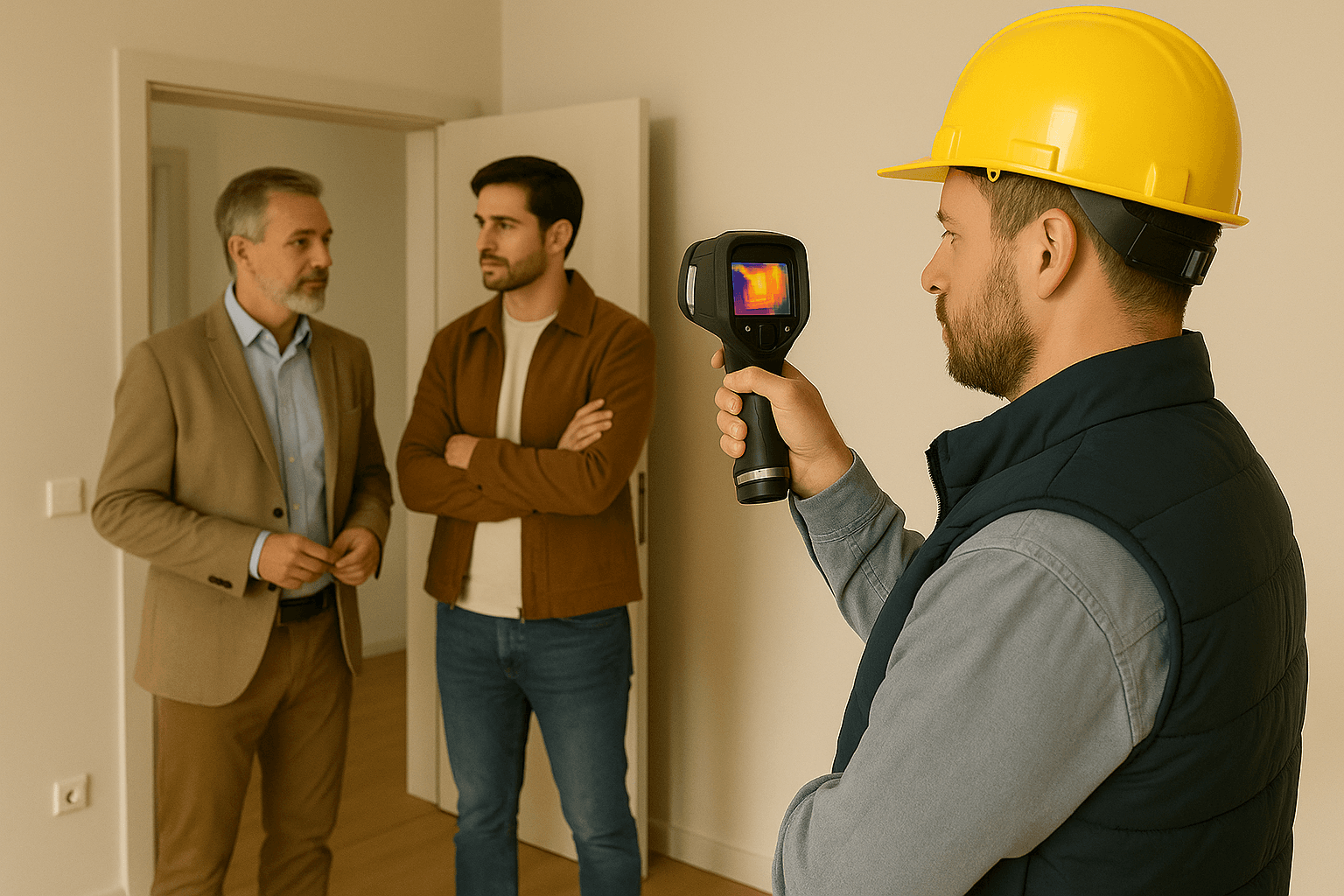
You typically call on such an expert after you’ve determined that the property meets your main criteria and you’re even ready to start price negotiations. The expert’s role is to thoroughly examine the condition of the property and building, pointing out hidden defects, structural problems, and urgent repairs. Key elements checked include moisture, leaks, electrical installation, insulation, roof, gutters, windows, doors, etc. Such an inspection can give you peace of mind, provide arguments in negotiations, or at least prepare you for the real expenses you’ll face after the purchase.
After the viewing
Do not rush into making an offer during the viewing. Give yourself time to carefully consider everything you’ve seen. If necessary, contact the seller again for additional information or even arrange a second viewing. Never let emotions drive you into hasty decisions – especially if someone is trying to pressure you.
Remember: the claim that ‘there are three more serious buyers’ is most likely not true.
Find out the value of the property you’re interested in. This will help you determine whether the price you’re paying reflects the actual market situation.
One of the main factors influencing property prices is supply and demand.
The property’s characteristics also play a key role in pricing – including size, location, type of property, condition, and other specifics.
Political and economic conditions also have a strong impact. The real estate market is directly tied to the state of the economy.
When interest rates are low, buying with credit is more affordable. This increases demand and, consequently, property prices. The opposite is also common: when interest rates rise, usually in times of economic uncertainty or crisis, demand decreases, which cools the market and lowers prices.
Key factors that determine property price:
- Location
- Type of property
- Neighborhood (micro-area)
- When and with what materials it was built
- Maintenance and renovations
- Size (living area, yard area)
- Availability of garage, parking space, or basement
- Infrastructure
- Current economic conditions
- Level of demand and supply
Is the price you’ll pay reasonable?
To understand whether the seller’s asking price is market-justified, compare it with similar properties in the area. For deeper insight and an objective assessment, we recommend consulting a licensed professional appraiser.
Negotiating the price, preliminary contract, and closing the deal
Before you acquire ownership of a property, it is important to be familiar with the legal aspects related to negotiations, the preliminary contract, and the notarial certification of the deal. In this section, we have gathered useful information to help you go through the process more confidently and calmly.
This stage of the purchase allows both parties to achieve a mutually satisfying result. To increase your chances of a successful agreement, here are a few tips:
- Approach negotiations without prejudice, with an open mind, and maintain a respectful tone.
- Prepare your budget in advance by researching the actual prices of similar properties on the local market.
- Set clear boundaries by determining the conditions on which you won’t compromise.
- Try to learn more about the seller and their expectations – this will help you formulate a better offer.
- Don’t forget: the goal is for both sides to be satisfied at the end of the negotiations.
Face-to-face
Many people prefer direct contact with the seller because it gives them a sense of greater control over negotiations. The advantage of this approach is that discussions are conducted without an intermediary, saving time, unnecessary misunderstandings, and tension. In such direct relations, it is clear whose interests are being represented on both sides of the deal.
Once you reach an agreement on the price, it’s time to sign a preliminary contract and, if necessary, pay a deposit (earnest money).
What do you negotiate?
The truth is, apart from the price, one of the most important topics during negotiations is the conditions of the deal. The preliminary contract can include clauses that protect your interests, for example:
- the right to inspection by a construction specialist before finalizing the deal;
- a clause for refund of the deposit if you are not approved for financing;
- clarification of what movable property remains in the home and what will be removed by the seller;
- an exact date for handover of possession;
Don’t underestimate these details – they are often key to a smooth and successful closing.
After reaching an agreement with the seller, it’s time to put all arrangements in writing. Don’t rely on verbal promises – it’s much better to have everything clearly stated in a preliminary contract.
The preliminary contract for the sale of real estate is an extremely important step in property transactions in Bulgaria, especially when:
- the buyer is financing the purchase through a mortgage;
- time is needed to prepare the necessary documents;
- the parties want additional guarantees and time before the notarial certification of the deal.
What is a preliminary contract?

It is an agreement between the seller and the buyer, under which both parties commit to signing a final contract (notarial deed) in the future under previously agreed terms. These terms must be clearly described and thoroughly discussed before signing. The preliminary contract has binding legal force, and if one of the parties withdraws without valid reason, the other party has the right to seek enforcement through court. This is done by filing a claim under Art. 19 of the Law on Obligations and Contracts (LOC) to ‘declare the preliminary contract final.’
What must a preliminary contract contain?
- Parties’ details – full names, personal ID number, permanent address, and ID document data (number, date of issue, issuing authority).
- Property description – exact address, type of property, built-up and/or total area, cadastral identifier (if available).
- Sale price – the full agreed amount, as well as the currency in which payment will be made.
- Deadline for signing the final (notarial) contract – usually within 30 to 90 days, unless otherwise agreed.
- Payment terms – method and stages of payment (deposit, bank transfer, loan, etc.).
- Penalty clauses – what happens if one of the parties withdraws or breaches the agreed terms.
- Condition of the property and obligations of the parties – including provision of documents such as certificate of encumbrances, tax valuation, cadastral sketch, occupancy permit, etc.
Anyone can draft a preliminary contract, but we strongly recommend consulting a lawyer to ensure you understand what you are signing. This way you avoid unclear clauses, hidden risks, and future complications. Always request a receipt or bank document for the paid deposit – this is your proof that the sum was actually transferred to the seller.
What documents should you request as a buyer?
- Notarial deed or other proof of ownership
- Property sketch – issued by the Agency for Geodesy, Cartography, and Cadastre
- Certificate of encumbrances – confirms the property is free of mortgages, seizures, or legal disputes
- Certificate of heirs – in the case of inherited properties
- Tax valuation of the property – required for notarial certification
- Certificate of no debts to the municipality – for local taxes and fees
Also make sure all co-owners are present and participate when signing the preliminary contract.
Does a preliminary contract need to be signed before a notary?
The answer is: not mandatory. However, it is advisable to have the contract at least reviewed by a lawyer to ensure the terms are correct and protect your interests.
Professional property inspection by a specialist
To be aware of any potential issues that could surprise you after the purchase, it is wise to consult a structural engineer. They will carry out a thorough inspection of the property and prepare a detailed report with findings. Such an inspection can also be included as a condition in the preliminary contract – a practice already common in many other countries. In Bulgaria too, companies now offer this service. They use modern, high-tech equipment that allows them to detect even hidden defects.
In Bulgaria, the transfer of property ownership must be completed before a notary. The notary certifies the deal through a notarial deed after verifying the identity and representative authority of the parties, the seller’s ownership rights, and the contents of the agreement. They also record the parties’ declarations of intent, register the deal in the Property Register, and collect the required fees on behalf of the state.
How does the process at the notary work?
The seller and the buyer prepare and present the required documents for the certification of the deal.
The seller provides:
- Notarial deed – proof of ownership;
- Tax valuation from the municipality;
- Certificate of encumbrances – proving the property is free of burdens;
- Certificate of marital status;
- Consent from spouse, if the property is marital community property;
- Property sketch (for land plots) – issued by AGCC, valid for 6 months;
- Certificate of address or name identity – in case of discrepancies in documents;
- Inspection report from a structural engineer or technical passport – not mandatory, but may be required by the buyer or in specific cases (especially for new construction or when financed by a bank);
- For inherited properties – certificates of heirs, wills, partition protocols, etc.;
- Identity documents
The buyer provides:
- Identity document
- Funds for payment
- Notarized power of attorney – if represented by another person;
- Certificate of marital status – in some cases (e.g., purchasing property with a spouse);
- Additional documents from the bank, if the deal is with a mortgage (pre-approval, loan agreement, etc.)
The notarial deed is signed by the parties in the presence of the notary, after the deed is read aloud. This is also the moment when payment is made (usually via bank transfer). After signing, the notary submits the document for registration at the Registry Agency. From that moment on, the buyer officially becomes the new owner. After registration (usually within a few days), the new owner receives the registered notarial deed as proof of ownership rights.
After the deal
On the date specified in the preliminary contract, you must take possession of the property. For this purpose, prepare a handover protocol in two copies – one for you and one for the seller. The protocol should record the condition of the property at handover and the meter readings for electricity, water, and heating, so it is clear where your responsibility as the new owner begins. Then you must file applications to transfer the utility accounts (electricity, water, district heating) so that future bills are issued in your name.
It is also important, within 2 months of registering the deal in the Property Register, to submit a declaration of new ownership to the ‘Local Taxes and Fees’ department of the respective municipality. This is necessary so that local taxes and fees (e.g., property tax, waste collection fee) can be calculated and charged.
If you plan to change your address registration (e.g., for ID documents or vehicle registration), you will also need to file an application with the relevant municipal administration.
And don’t forget – all properties published here are directly from the owner and this is verified!